Those of us in Rwanda are seeing God's hand at work in ways we never anticipated and we are blessed to be part of God's purposes for this nation. There is obviously growing support for our application for our mission organization. We have been developing good relationships with officials and their input has been extremely helpful, from the mudugudu (zone), cell, sector and district level offices. We are also having to make changes and do rewrites of some of our documentation to fit the requirements of the different departments. We are making good progress however.
One thing we have become convinced of in the last three weeks of pursuing our Africa Transformation Network registration is this: We will not get the registration approved by our local district until we start work, until we have a physical location of an office and work space and until we demonstrate that we are actually doing what we listed in our plan of action. From the beginning we were under the impression that we needed the registration in order to have permission to begin. But in fact, we must begin in order to secure the registration. So... let the work begin ...
One of the major decisions we made last week was to bring Charles Kabeza on board to work with us full-time as an administrative assistant. He will begin his role with us on July 1. Charles graduated from university last year with a degree in economics. He has recently, on his own initiative with encouragement from some of us, begun a ministry to genocide orphans which demonstrates that he is a man of faith and compassion. (See http://www.christianchronicle.org/article2158310~Ministry_to_help_orphans_in_Rwanda ).
A second decision was to find and rent a property to serve as a center from which to work and to house our ATN offices. In addition to what already is being done with Extra Mile ministries, we have the resources to begin two or three of the projects in our plan of action. We need to get those projects up and running as soon as possible.
Personally, I feel both excited and challenged. Decisions that were made in our meeting last week have pushed us to a new level. I believe it is going to take a higher level of commitment and a greater degree of faith for all of us. It is a little like walking on water; we are not sure about the water, but we are sure about the God who called us and is faithful to sustain us.
The budget we formulated and presented to Kicukiro district is for $94,960 in our first year. We only have 30% of the budget raised at present (half of that committed by ATN founding members). But we trust that God will provide the funding that is lacking.
Monday, June 30, 2008

Tuesday, May 20, 2008
The Call of God to Sudan
Sudan has suffered through two lengthy civil wars since 1956. In January, 2005 a comprehensive peace agreement was signed to end the Second Sudanese Civil War, develop democratic governance countrywide and set a timetable by which Southern Sudan would have a referendum on its independence. The referendum is scheduled for 2011. The Sudanese people I know have high expectations that national independence will become a reality at that time.
I believe NOW is the time Christians should prepare to serve in 'New Sudan.' There is now a huge need for a holistic approach to meeting the various needs of the people of Sudan. Physical and institutional infrastructure has been severely degraded and millions of people have been displaced as a result of recent wars. Church planting and supporting services are priority, but they must be accompanied by assistance in the fields of health, education, agriculture, trades training and small business training, etc.
 Nancy and I hosted day of prayer and planning for missions in Sudan at the Richland Hills Church of Christ in Fort Worth, TX on May 17, 2008. The meeting was attended by 21 people representing teams in formation, Sudanese nationals, leaders of interested supporting churches, missionary candidates and others considering missions in Sudan. The purpose of the meeting was to hear reports on recent missions to Sudan, to share plans for service there and pray the Lord of Harvests to raise up and send forth workers to the fields ready and ripe for the gospel. For more information, contact me at missions@mrnet.org
I believe NOW is the time Christians should prepare to serve in 'New Sudan.' There is now a huge need for a holistic approach to meeting the various needs of the people of Sudan. Physical and institutional infrastructure has been severely degraded and millions of people have been displaced as a result of recent wars. Church planting and supporting services are priority, but they must be accompanied by assistance in the fields of health, education, agriculture, trades training and small business training, etc.
 Nancy and I hosted day of prayer and planning for missions in Sudan at the Richland Hills Church of Christ in Fort Worth, TX on May 17, 2008. The meeting was attended by 21 people representing teams in formation, Sudanese nationals, leaders of interested supporting churches, missionary candidates and others considering missions in Sudan. The purpose of the meeting was to hear reports on recent missions to Sudan, to share plans for service there and pray the Lord of Harvests to raise up and send forth workers to the fields ready and ripe for the gospel. For more information, contact me at missions@mrnet.org
Wednesday, April 16, 2008
Disciple-makers are disciples in the making
My task last week was to teach 22 Zambian Christian school teachers a course on Missions in Africa. George Benson Christian College has been training school teachers for 20 years or so. Of late the Zambian government has not been hiring all of the teachers that the college graduates. So a fund has been set up to provide these teachers a minimal stipend and place them with schools in northern Zambia where there is need for churches to be planted.
 When I heard about this my thought was, 'Why not educate some of these teachers in the principles of missions, cross-cultural communication and church planting, then challenge those whom God calls to such work, to become vocational missionaries in nations where English and school teachers are in demand?' This was the goal of my course at Mapepe Bible College near Lusaka.
In telling about mission opportunities I focused on Congo, Angola, Mozambique, Rwanda and Sudan. Six or eight of the students showed great interest in these possibilities. Some will attend a church planting movements workshop in July.
 When I heard about this my thought was, 'Why not educate some of these teachers in the principles of missions, cross-cultural communication and church planting, then challenge those whom God calls to such work, to become vocational missionaries in nations where English and school teachers are in demand?' This was the goal of my course at Mapepe Bible College near Lusaka.
In telling about mission opportunities I focused on Congo, Angola, Mozambique, Rwanda and Sudan. Six or eight of the students showed great interest in these possibilities. Some will attend a church planting movements workshop in July.
Saturday, April 12, 2008
Another of God's Surprises
Two weeks ago my sister Claudia and her husband Jerry arrived from the U. S. to visit Nancy and me in Rwanda and then to accompany us to Zambia. Why had they come at this time? It was another of God's many surprises. Claudia said that Jerry, who is retiring this July from more than 30 years of teaching medicine at the University of Missouri, Columbia, MO, abruptly said to her one day, "What would you think about us going to work in Zambia for a while?" She was taken aback as he had never indicated any interest in doing such a thing before. Apparently Jerry was thinking about some way to serve others in his retirement years.
 Of course, when I heard that they wanted to visit us in Rwanda on their way to doing some fact-finding in Zambia, I immediately hatched a plan to recruit Claudia and Jerry for Rwanda. We set up interviews with individuals in the medical field and various health institutions including the medical school at the National University in Butare and others in Kigali. We toured facilities and asked a lot of questions.
Then we flew to Lusaka, Zambia where Jerry had contacts and appointments with health officials at the University Teaching Hospital there. For two days he worked alongside an ENT doctor (Jerry's specialty) examining patients in clinics in the hospital. Then he was given a strong invitation to join the staff there where he would be able to teach candidates in the field of Ear, Nose and Throat surgery. After comparing opportunities to serve in either Rwanda or in Zambia, Jerry felt that he would actually be able to use his skills and accomplish more by teaching at the University of Zambia. So he decided to accept the invitation.
Nancy and I would have loved to have Jerry and Claudia live near us in Rwanda, but Claudia was born and grew up in Zambia, so perhaps it is fitting that she and Jerry will get to serve the people there again at this stage of their lives. I hope their example of retirees who want to continue using their skills to serve people for a few more years, will inspire others to venture out to the places in the world where opportunities to serve are many and where needs are great!
 Of course, when I heard that they wanted to visit us in Rwanda on their way to doing some fact-finding in Zambia, I immediately hatched a plan to recruit Claudia and Jerry for Rwanda. We set up interviews with individuals in the medical field and various health institutions including the medical school at the National University in Butare and others in Kigali. We toured facilities and asked a lot of questions.
Then we flew to Lusaka, Zambia where Jerry had contacts and appointments with health officials at the University Teaching Hospital there. For two days he worked alongside an ENT doctor (Jerry's specialty) examining patients in clinics in the hospital. Then he was given a strong invitation to join the staff there where he would be able to teach candidates in the field of Ear, Nose and Throat surgery. After comparing opportunities to serve in either Rwanda or in Zambia, Jerry felt that he would actually be able to use his skills and accomplish more by teaching at the University of Zambia. So he decided to accept the invitation.
Nancy and I would have loved to have Jerry and Claudia live near us in Rwanda, but Claudia was born and grew up in Zambia, so perhaps it is fitting that she and Jerry will get to serve the people there again at this stage of their lives. I hope their example of retirees who want to continue using their skills to serve people for a few more years, will inspire others to venture out to the places in the world where opportunities to serve are many and where needs are great!
Sunday, March 09, 2008
Jacqueline, tell us who you are!
The neighborhood clean-up day here once a month provides an opportunity for people to spend a Saturday working on a particular project or simply filling in some holes in the roads. It also gives the Zone Leader a chance to meet with people to assess any problems or needs. Showing up late for our first meeting with shovel and rakes in hand, we found about 60 people gathered on the hillside already finished shoveling but reading out names and taking care of business of the neighborhood. Our arrival was noticed, being the only 'wazungu' (white people) around, and we were given a warm welcome and introduced.
 Unknown to us, our neighbor, Eron, had already let it be known that we needed someone to work in the house, and the matter was brought before the Zone Leader at that time. The next day Eron appeared at my door with Jacqueline and informed us that this lady would release me from my broom and dish cloth and allow me to get on with more important tasks, while I would be providing someone employment, a single mom raising four girls, ages 8, 10, 11, and 14.
We learned a little of Jacqueline's story, but only weeks later heard more: that she and her family had escaped to Burundi during the genocide of 1994, and that her husband had fled to the Congo soon after that upheaval, and she has not seen him since. Already a trained teacher, she returned to Kigali after the genocide and managed to get a job with a European NGO and was trained in French tailoring and began teaching orphans and widows how to sew. Unfortunately the project closed because of lack of funds and the Europeans left, but gave Jacqueline a sewing machine and equipment to continue her own tailoring business. She managed to support her girls and pay their school fees while building a reputation for making beautiful traditional dresses for clients as they brought their own fabrics to her. Only recently however, a thief took her sewing machine and all her equipment, and that is why she stepped forward that day at the neighborhood meeting, seeking a job.
No one in our neighborhood could have known that I have had it in my heart for months and even years to help teach skills to women and now older orphans who have been left behind in their education, and that sewing was one of my first dreams to begin with! What was God saying to me by bringing this beautiful lady so skilled in this area to my home? I am sharing this with you as only the beginning of the story. We cannot predict how God will continue His work He has for us.
 Unknown to us, our neighbor, Eron, had already let it be known that we needed someone to work in the house, and the matter was brought before the Zone Leader at that time. The next day Eron appeared at my door with Jacqueline and informed us that this lady would release me from my broom and dish cloth and allow me to get on with more important tasks, while I would be providing someone employment, a single mom raising four girls, ages 8, 10, 11, and 14.
 We learned a little of Jacqueline's story, but only weeks later heard more: that she and her family had escaped to Burundi during the genocide of 1994, and that her husband had fled to the Congo soon after that upheaval, and she has not seen him since. Already a trained teacher, she returned to Kigali after the genocide and managed to get a job with a European NGO and was trained in French tailoring and began teaching orphans and widows how to sew. Unfortunately the project closed because of lack of funds and the Europeans left, but gave Jacqueline a sewing machine and equipment to continue her own tailoring business. She managed to support her girls and pay their school fees while building a reputation for making beautiful traditional dresses for clients as they brought their own fabrics to her. Only recently however, a thief took her sewing machine and all her equipment, and that is why she stepped forward that day at the neighborhood meeting, seeking a job.
No one in our neighborhood could have known that I have had it in my heart for months and even years to help teach skills to women and now older orphans who have been left behind in their education, and that sewing was one of my first dreams to begin with! What was God saying to me by bringing this beautiful lady so skilled in this area to my home? I am sharing this with you as only the beginning of the story. We cannot predict how God will continue His work He has for us.
Monday, February 25, 2008
God's Amazing Work in Rwanda
Sometimes missionaries like to have fun. Last Saturday we borrowed a couple of kayaks and went down to Lake Muhazi. A very bumpy road and 2 hrs journey-- I think we got on the wrong road, we were told it's a 45 min. drive. Anyway we had a great time. Took a picnic, and I found a good tree to relax under and read a book while everyone else took turns kayaking. As we finished our picnic on an empty lot by the lake, the owner of the lot next to us invited us over to see how he was developing his property.  I said a silent prayer that this would be a ‘God-connection.’ We met Emmanuel who could speak English and we mentioned in passing that we were considering looking for a lakeside property we might develop as a youth camp and training center. He said he was a Christian and immediately began casting a vision for exactly what we were thinking of. Emmanuel said he would like to help us look for a site. We are constantly amazed and humbled at the evidence that God has been at work in minds and hearts long before we got here.
In Rwanda, the last Saturday of the month is known as Umuganda (community work) Day. Men and women in a neighborhood gather to work on a community project or clean up the neighborhood. Though this work is not required of non-Rwandans, we find it an opportunity to meet people in our area. Last month they had a organizational meeting after the work and the zone leader whom we had already met asked us to introduce ourselves. After the meeting, we had numerous people introduce themselves to us. They have been so welcoming and helpful to us. At our last U day about 100 people turned out. Our zone leader, Emmanuel, is the export manager for a coffee company here. He organized us into work parties to repair some bad places on a neighborhood street. After greeting me he said, “I have heard that you have worship and prayer in your home. Is it okay if I join you for that.” You can guess my answer! At the end of the meeting Chris and I walked up the hill in a line of people and when we got to our street, a big man introduced himself and welcomed us to the neighborhood. He pointed to his house about 150 metres away and said he would like to have us over for tea soon. He asked us where we were from and when we said the U. S. A., he said, “Oh, my daughter is in the U. S. She is studying at Oklahoma Christian University.” Okay!
 I said a silent prayer that this would be a ‘God-connection.’ We met Emmanuel who could speak English and we mentioned in passing that we were considering looking for a lakeside property we might develop as a youth camp and training center. He said he was a Christian and immediately began casting a vision for exactly what we were thinking of. Emmanuel said he would like to help us look for a site. We are constantly amazed and humbled at the evidence that God has been at work in minds and hearts long before we got here.
In Rwanda, the last Saturday of the month is known as Umuganda (community work) Day. Men and women in a neighborhood gather to work on a community project or clean up the neighborhood. Though this work is not required of non-Rwandans, we find it an opportunity to meet people in our area. Last month they had a organizational meeting after the work and the zone leader whom we had already met asked us to introduce ourselves. After the meeting, we had numerous people introduce themselves to us. They have been so welcoming and helpful to us. At our last U day about 100 people turned out. Our zone leader, Emmanuel, is the export manager for a coffee company here. He organized us into work parties to repair some bad places on a neighborhood street. After greeting me he said, “I have heard that you have worship and prayer in your home. Is it okay if I join you for that.” You can guess my answer! At the end of the meeting Chris and I walked up the hill in a line of people and when we got to our street, a big man introduced himself and welcomed us to the neighborhood. He pointed to his house about 150 metres away and said he would like to have us over for tea soon. He asked us where we were from and when we said the U. S. A., he said, “Oh, my daughter is in the U. S. She is studying at Oklahoma Christian University.” Okay!
Monday, October 29, 2007
2007 Mission to Raja-Boro, Sudan
It was one of the most complex and faith-stretching experiences I have ever been involved with. It was a mission to serve Darfur refugees in Jesus’ name. One of the greatest challenges was defining where and how the mission could and would take place. Another was coordinating the planning, funding and communications with 22 men from 5 countries, some of whom we didn’t have direct connection with until hours before departure on the mission from Kenya.
 

While some of our team were gathering in Nairobi from Bangkok, St. Petersburg, Lusaka, Zambia and Accra, Ghana, others were leaving from Arizona, Missouri, Tennessee and Texas. We all gathered in Nairobi to finalize our documentation to enter South Sudan. On July 17, our team began the journey north in two shifts to arrive on consecutive days at our destination in south-western Sudan where we had heard there were refugees needing help. But we had no ‘hard’ information about the place (other than that the runway was short and the rains were heavy) and no communication with anyone in the area. I felt like we were ‘flying blind.’ So we had a contingency plan to do a quick survey before landing and be prepared to take off for another location if there was a hostile reception in Raja.
Meanwhile, hundreds of people were praying for ‘people of peace’ (Luke 10, Matt. 10) to receive us when we landed. The first group to land were met by the leaders of the town and the county and immediately taken to the offices of the Commissioner of the Raja County. They were introduced, welcomed and assigned a place to camp on the edge of the town of Raja: the compound of the Red Crescent. The ‘green light’ was given the second half of the team to fly in the next day. I was on that second flight and was surprised when I was met by Edward, the acting Commissioner of Raja County who said, “Are you Sam?” When I said yes, he said, “Please your transport is over here.” He immediately bundled us all into two pickups and took us to the county offices. It was hard to believe the warm reception, the cooperativeness, the offers of help, the desire to understand our mission, the provision of bedding and transportation put at our disposal ... all of this, without any advance notice that we were coming!! It was a huge encouragement to all of us. At the same time, it was disappointing that the refugee camp was 63 miles away and by some reports inaccessible by road. We saw serving Darfur refugees as a primary purpose of the mission. How could we possible get there? The first few days in Raja were spent setting up camp, organizing ourselves into teams for different tasks, getting to know the town of Raja, prayer-walking through its streets(?), surveying and serving in local medical facilities and, very importantly, meeting and beginning to build relationships with a stream of people who came by our camp to greet us and find out what our mission was. We also interviewed local U. N. officials, other aid missions, the police, army and local government departments to find how get to and serve in the refugee camp. It was decided that we would need to send out a scouting team to the area to check out the condition of the road and living conditions in the camp.

We sent out our ‘Caleb Corps,’ a team of young men, guides and police guards who made the arduous 5-hour trip to the camp by motorcycle over a rugged forest track through rain and marshes. Their mission was to make a brief survey of the needs in the camp and to determine the feasibility of the larger team getting there and doing something to help the 'internally displaced people' there. The corps arrived there late in the afternoon and checked out conditions and needs in the camp. They surveyed what they thought we could do and what it would take for a larger crew to get there. Because the security situation was unclear, this team of scouts was under orders to return the same day. So the any set off on their return journey about 4:30 p.m. already close to exhaustion from exposure to the tropical sun and physical exertion. They dragged into Raja a little after 9 that night completely worn out but optimistic about what our mission could do.
That weekend we began to plan in earnest for a mission to Boro-Medina. The hospital, the police and the Islamic school in Raja each offered to loan us a vehicle to get to Boro. Our friend, Isaac Suliman, the chief of police arranged an armed guard to accompany us. Our part was to provide fuel for the vehicles and food for the drivers and guards as well as all the supplies we would need.
On the Monday, after many delays and much indecision, we set off for Boro-Medina. It was an arduous four-and-a-half-hour drive. We arrived a couple up hours before dark and immediately went to work setting up camp. Some slept in the camp director's office area, others had tents in the yard.
The next morning Dr. Mike Smith and Glenn Berkey left camp early to set up and organize a medical clinic. Other members of our team served as assistants, interpreters and maintained order in the lines of people. That day more than 500 hundred patients were interviewed, examined and treated. Some of the common diseases were typhoid, tuberculosis and other respiratory ailments and a number of cases of epilepsy. Others of our team did prayer-walks throughout the camp, prayed for mothers and their children. We found that there were few men in the camp. Surveys were made of the local school, available housing, water supplies, airstrip, medical facilities, roads and availability of food. We had previously made arrangements with local World Food Program directors in Raja to help with distributing food supplies to hungry people in the camp. The WFP had a large tent in Boro that was locked. There were food supplies in the tent, but no arrived during our time in Boro to unlock the tent and make food available to the people of the camp. We actually spent on parts of three days at Boro.
The Journey...
In my view, the most important story of our journey was the many small and great acts God did in response to prayers of so many of our friends who were in regular intercession for the mission. As an example, one small act of God that blessed me in a big way was the woman from Gibraltar who sat next to me on our flight from London to Nairobi. As we walked up the jetway in Nairobi, she pulled me aside and asked me to accept a $100 bill for our Sudan mission. Wow! A complete stranger (angel?).
For me personally, the greatest struggle was inside of me; my personal struggle to truly trust God in all this. I had never taken on the responsibility of leading so many (over 20 men including my two sons) from so many places, to such a remote location with so little knowledge about what was there, what the mission would be and whether we could actually even land a plane there.
 
While some of our team were gathering in Nairobi from Bangkok, St. Petersburg, Lusaka, Zambia and Accra, Ghana, others were leaving from Arizona, Missouri, Tennessee and Texas. We all gathered in Nairobi to finalize our documentation to enter South Sudan. On July 17, our team began the journey north in two shifts to arrive on consecutive days at our destination in south-western Sudan where we had heard there were refugees needing help. But we had no ‘hard’ information about the place (other than that the runway was short and the rains were heavy) and no communication with anyone in the area. I felt like we were ‘flying blind.’ So we had a contingency plan to do a quick survey before landing and be prepared to take off for another location if there was a hostile reception in Raja.
Meanwhile, hundreds of people were praying for ‘people of peace’ (Luke 10, Matt. 10) to receive us when we landed. The first group to land were met by the leaders of the town and the county and immediately taken to the offices of the Commissioner of the Raja County. They were introduced, welcomed and assigned a place to camp on the edge of the town of Raja: the compound of the Red Crescent. The ‘green light’ was given the second half of the team to fly in the next day. I was on that second flight and was surprised when I was met by Edward, the acting Commissioner of Raja County who said, “Are you Sam?” When I said yes, he said, “Please your transport is over here.” He immediately bundled us all into two pickups and took us to the county offices. It was hard to believe the warm reception, the cooperativeness, the offers of help, the desire to understand our mission, the provision of bedding and transportation put at our disposal ... all of this, without any advance notice that we were coming!! It was a huge encouragement to all of us. At the same time, it was disappointing that the refugee camp was 63 miles away and by some reports inaccessible by road. We saw serving Darfur refugees as a primary purpose of the mission. How could we possible get there? The first few days in Raja were spent setting up camp, organizing ourselves into teams for different tasks, getting to know the town of Raja, prayer-walking through its streets(?), surveying and serving in local medical facilities and, very importantly, meeting and beginning to build relationships with a stream of people who came by our camp to greet us and find out what our mission was. We also interviewed local U. N. officials, other aid missions, the police, army and local government departments to find how get to and serve in the refugee camp. It was decided that we would need to send out a scouting team to the area to check out the condition of the road and living conditions in the camp.

We sent out our ‘Caleb Corps,’ a team of young men, guides and police guards who made the arduous 5-hour trip to the camp by motorcycle over a rugged forest track through rain and marshes. Their mission was to make a brief survey of the needs in the camp and to determine the feasibility of the larger team getting there and doing something to help the 'internally displaced people' there. The corps arrived there late in the afternoon and checked out conditions and needs in the camp. They surveyed what they thought we could do and what it would take for a larger crew to get there. Because the security situation was unclear, this team of scouts was under orders to return the same day. So the any set off on their return journey about 4:30 p.m. already close to exhaustion from exposure to the tropical sun and physical exertion. They dragged into Raja a little after 9 that night completely worn out but optimistic about what our mission could do.
That weekend we began to plan in earnest for a mission to Boro-Medina. The hospital, the police and the Islamic school in Raja each offered to loan us a vehicle to get to Boro. Our friend, Isaac Suliman, the chief of police arranged an armed guard to accompany us. Our part was to provide fuel for the vehicles and food for the drivers and guards as well as all the supplies we would need.
On the Monday, after many delays and much indecision, we set off for Boro-Medina. It was an arduous four-and-a-half-hour drive. We arrived a couple up hours before dark and immediately went to work setting up camp. Some slept in the camp director's office area, others had tents in the yard.
The next morning Dr. Mike Smith and Glenn Berkey left camp early to set up and organize a medical clinic. Other members of our team served as assistants, interpreters and maintained order in the lines of people. That day more than 500 hundred patients were interviewed, examined and treated. Some of the common diseases were typhoid, tuberculosis and other respiratory ailments and a number of cases of epilepsy. Others of our team did prayer-walks throughout the camp, prayed for mothers and their children. We found that there were few men in the camp. Surveys were made of the local school, available housing, water supplies, airstrip, medical facilities, roads and availability of food. We had previously made arrangements with local World Food Program directors in Raja to help with distributing food supplies to hungry people in the camp. The WFP had a large tent in Boro that was locked. There were food supplies in the tent, but no arrived during our time in Boro to unlock the tent and make food available to the people of the camp. We actually spent on parts of three days at Boro.
The Journey...
In my view, the most important story of our journey was the many small and great acts God did in response to prayers of so many of our friends who were in regular intercession for the mission. As an example, one small act of God that blessed me in a big way was the woman from Gibraltar who sat next to me on our flight from London to Nairobi. As we walked up the jetway in Nairobi, she pulled me aside and asked me to accept a $100 bill for our Sudan mission. Wow! A complete stranger (angel?).
For me personally, the greatest struggle was inside of me; my personal struggle to truly trust God in all this. I had never taken on the responsibility of leading so many (over 20 men including my two sons) from so many places, to such a remote location with so little knowledge about what was there, what the mission would be and whether we could actually even land a plane there.
Sunday, July 01, 2007
Two Milestones on the Road to Rwanda
We are praising the Lord for two major milestones on our road to serving God again in Africa.
These two events took place last Thursday. First we loaded a 40 ft. container with three other families planning to serve in Rwanda. Most of the shipment was books and other supplies for the new mission in Rwanda, but it also included personal effects for the families going. It was a hot and rainy day, but we got the container loaded in about 6 hours.
The second milestone was more important to us personally. For some weeks we have been agonizing over whether to sell our house or make it available to missionaries on furlough on a month to month rental basis. We thought we could leave our house furnished and our furniture in place. Through prayer and advice from others we decided that was not a workable idea, so we put the house on the market. Quite honestly this was a big struggle for me: to liquidate everything again for the fourth time in forty years and to again be homeless. Knowing also that we are in a real estate slump we anticipated that we would likely take a huge loss on the sale or worse yet, get on the plane for Rwanda with an empty, unrented, unsold house on our hands.
A week ago Wednesday night we asked the prayer group we are a part of to pray for a miracle as the house went on the market; to pray for a buyer who wanted the house as much as we needed to sell it. God blessed these prayers and the step of faith! Again this Wednesday night our friends were praying with us for our house to sell. The next day, the fifth day the house was on the market we got two offers for the house, one for the full asking price and the other for $1000 less.
We accepted the latter offer because it is a cash offer and the buyer agreed to delay the closing day until August 13, two weeks after I return from a mission to South Sudan. That will give us time to pack and move out. How gracious and kind our Father is!! Please praise God with us!!
These two events took place last Thursday. First we loaded a 40 ft. container with three other families planning to serve in Rwanda. Most of the shipment was books and other supplies for the new mission in Rwanda, but it also included personal effects for the families going. It was a hot and rainy day, but we got the container loaded in about 6 hours.
The second milestone was more important to us personally. For some weeks we have been agonizing over whether to sell our house or make it available to missionaries on furlough on a month to month rental basis. We thought we could leave our house furnished and our furniture in place. Through prayer and advice from others we decided that was not a workable idea, so we put the house on the market. Quite honestly this was a big struggle for me: to liquidate everything again for the fourth time in forty years and to again be homeless. Knowing also that we are in a real estate slump we anticipated that we would likely take a huge loss on the sale or worse yet, get on the plane for Rwanda with an empty, unrented, unsold house on our hands.
A week ago Wednesday night we asked the prayer group we are a part of to pray for a miracle as the house went on the market; to pray for a buyer who wanted the house as much as we needed to sell it. God blessed these prayers and the step of faith! Again this Wednesday night our friends were praying with us for our house to sell. The next day, the fifth day the house was on the market we got two offers for the house, one for the full asking price and the other for $1000 less.
We accepted the latter offer because it is a cash offer and the buyer agreed to delay the closing day until August 13, two weeks after I return from a mission to South Sudan. That will give us time to pack and move out. How gracious and kind our Father is!! Please praise God with us!!
Thursday, March 29, 2007
Remembering William Siang'andu
Nancy and I have been joining many others in mourning the loss of William Siang'andu to malaria. William came from humble beginnings and supported his family as a bricklayer and builder. He was educated through the 10th grade and later studied at Manzini Bible School in Swaziland where his potential and vision for ministry in the kingdom was nourished.
  William and Eness traveled with us over lake and land last summer for five weeks from Zambia through Burundi, Rwanda, Uganda, Kenya and Tanzania. Their purpose on the journey was to learn all they could about how to care for orphans which has become a huge need in much of Africa as a result of war, genocide, AIDS and other diseases. It was a great joy to us to see their vision for ministry grow as a result of their experiences on that journey.
 William and Eness traveled with us over lake and land last summer for five weeks from Zambia through Burundi, Rwanda, Uganda, Kenya and Tanzania. Their purpose on the journey was to learn all they could about how to care for orphans which has become a huge need in much of Africa as a result of war, genocide, AIDS and other diseases. It was a great joy to us to see their vision for ministry grow as a result of their experiences on that journey.
Only weeks ago, William had accepted a position on the staff of Mapepe Bible School where he would have the opportunity to influence many for missions in Zambia and beyond. He fell ill to malaria as he has so many times in the past, before Eness and his children had actually joined him at Mapepe.
I am left to wonder what can be done about one the scourges of Africa: Malaria. How can we continue to prepare soldiers for the battle and then see them fall before they reach their potential to a debilitating disease that is so hard to eradicate, but so easy to control?
For now, we want to say that we join with many others in the family of God in expressing our deepest sympathies in what is a loss for all of us, but especially for Eness and their children. May we not forget to hold up our sister Eness' hands during her time of grieving. Our prayer is that she may somehow be able to carry on with their dream of caring for orphans in the nurture of the Lord, and that God will provide for her in this important ministry.
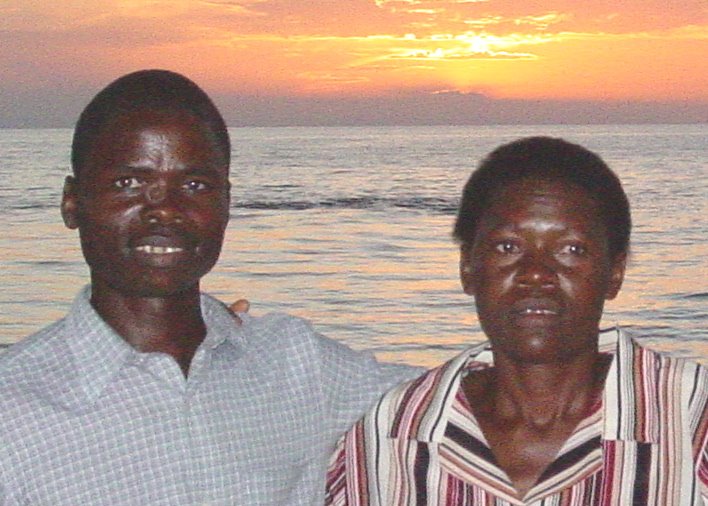  William and Eness traveled with us over lake and land last summer for five weeks from Zambia through Burundi, Rwanda, Uganda, Kenya and Tanzania. Their purpose on the journey was to learn all they could about how to care for orphans which has become a huge need in much of Africa as a result of war, genocide, AIDS and other diseases. It was a great joy to us to see their vision for ministry grow as a result of their experiences on that journey.
 William and Eness traveled with us over lake and land last summer for five weeks from Zambia through Burundi, Rwanda, Uganda, Kenya and Tanzania. Their purpose on the journey was to learn all they could about how to care for orphans which has become a huge need in much of Africa as a result of war, genocide, AIDS and other diseases. It was a great joy to us to see their vision for ministry grow as a result of their experiences on that journey.Only weeks ago, William had accepted a position on the staff of Mapepe Bible School where he would have the opportunity to influence many for missions in Zambia and beyond. He fell ill to malaria as he has so many times in the past, before Eness and his children had actually joined him at Mapepe.
I am left to wonder what can be done about one the scourges of Africa: Malaria. How can we continue to prepare soldiers for the battle and then see them fall before they reach their potential to a debilitating disease that is so hard to eradicate, but so easy to control?
For now, we want to say that we join with many others in the family of God in expressing our deepest sympathies in what is a loss for all of us, but especially for Eness and their children. May we not forget to hold up our sister Eness' hands during her time of grieving. Our prayer is that she may somehow be able to carry on with their dream of caring for orphans in the nurture of the Lord, and that God will provide for her in this important ministry.
Tuesday, February 06, 2007
Doing Something about Darfur
A few weeks ago I woke up in the morning with Darfur on my mind. I had recently read a news story that George Clooney had said that the United States ought to do something to ‘Save Darfur.’ Well, I agree, but think about it. Does the United States have any interest in Sudan? Not really. Maybe to prevent some terrorism or to get some oil. But Christians ought to care enough about the genocide going on there to care and to do something.
Let me go back a few years... to 1994. I was teaching at the Nairobi Great Commission School and hell was happening in Rwanda. I went to interdenominational meetings to discuss how we should respond to the horror in Rwanda. Ken Bolden and I talked with our faculty about what we ought to do. Should we shut down the school and take our students to Rwanda or Tanzania and help in the refugee camps? Well, in the end we did nothing. I have regretted that decision for a long time.
And now there is genocide in Darfur. There are Arab Muslims killing, raping and burning the villages of Muslims who are black. Can Christians stand by and do nothing about this? How am I going to feel 12 years from now if we do nothing? Of course, it's not about me or how I feel. It is about the NAME ... the Name we wear. What would Jesus do?
I proposed going into the area with multiple small teams prepared and accompanied by experienced spiritual mentors late this summer. The purpose would be two-fold: 1) to serve the suffering by demonstrating Jesus' compassion, and 2) to learn and teach what it means for African and western Christians to work together in a context of suffering, servanthood, submission and simplicity with Spirit-led lives. These teams would arrive at different times overlapping with others, would devote a minimum of 10 days in the area, be prepared for unpredictable circumstances and rough conditions, and would work under the supervision and planning of local leaders. More to come ...
Let me go back a few years... to 1994. I was teaching at the Nairobi Great Commission School and hell was happening in Rwanda. I went to interdenominational meetings to discuss how we should respond to the horror in Rwanda. Ken Bolden and I talked with our faculty about what we ought to do. Should we shut down the school and take our students to Rwanda or Tanzania and help in the refugee camps? Well, in the end we did nothing. I have regretted that decision for a long time.
And now there is genocide in Darfur. There are Arab Muslims killing, raping and burning the villages of Muslims who are black. Can Christians stand by and do nothing about this? How am I going to feel 12 years from now if we do nothing? Of course, it's not about me or how I feel. It is about the NAME ... the Name we wear. What would Jesus do?
I proposed going into the area with multiple small teams prepared and accompanied by experienced spiritual mentors late this summer. The purpose would be two-fold: 1) to serve the suffering by demonstrating Jesus' compassion, and 2) to learn and teach what it means for African and western Christians to work together in a context of suffering, servanthood, submission and simplicity with Spirit-led lives. These teams would arrive at different times overlapping with others, would devote a minimum of 10 days in the area, be prepared for unpredictable circumstances and rough conditions, and would work under the supervision and planning of local leaders. More to come ...
Subscribe to:
Posts (Atom)